how we steer hermes
an engineering session on the plugin that checks every hermes tool call before it runs: where it hooks in, how it decides, and how enforcement went from 700ms to 0.7ms.
hermes agents run behind chat gateways and on crons, often with nobody watching. by the time anyone reads the logs, the tool call has already happened. this is the code that gets in between: a walkthrough with a live run, then twenty minutes of open q&a.
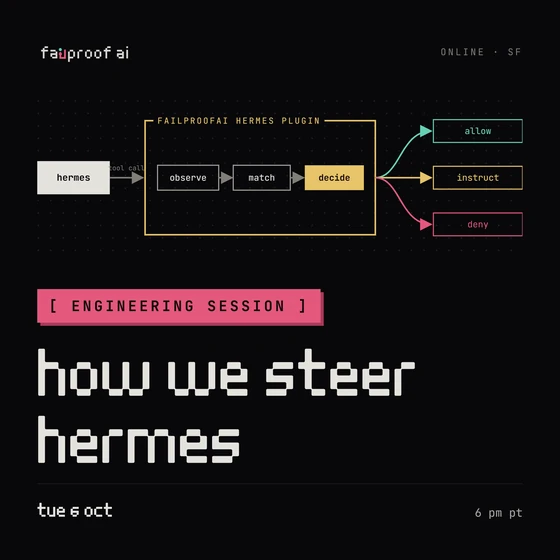
what it's about
hermes agents run behind chat gateways and on crons, often with nobody watching. when one goes wrong, the tool call has already happened by the time anyone looks at the logs.
this session is about the plugin we built for hermes that intercepts tool calls before they execute, and the three answers it can give back: allow, deny, or instruct.
- 01where the plugin hooks into hermes
which events we listen to, what the plugin sees at each one, and where in the agent loop a decision can still change the outcome.
- 02observe, match, decide
how a tool call gets turned into something a policy can check, how policies match on it, and how we pick between allow, deny and instruct.
- 03keeping it fast
enforcement used to start a fresh process per tool call and cost around 700ms before a policy even ran. we moved it to a warm daemon and got p50 down to about 0.7ms.
- 04writing instructions an agent actually follows
blocking is easy. getting the agent to do the right thing after a deny is harder, and the wording matters more than you'd think.
- 05what broke along the way
the edge cases, the policies that misfired, and what we'd do differently.
- 06your questions, live
the last 20 minutes are open. bring your own hermes setup and the failure you keep hitting.
how the day runs
all times pdt · subject to change- 15 minhow the plugin fits into hermestalk
which events it listens to, what it sees at each one, and where in the agent loop a decision can still change the outcome.
- 25 minwalkthrough of the code and a live runtalk
observe, match, decide, and the move to a warm daemon that took enforcement from around 700ms to about 0.7ms at p50.
- 20 minopen q&asocial
bring your own hermes setup and the failure you keep hitting.
who's on
- SPEAKERChetan Raghuvanshifounding engineer @ failproof ai
built the hermes plugin, and walks through how it works from the inside: the hook points, the decision path, and the rewrite that took enforcement from 700ms to 0.7ms.
x - HOSTSahar Morbond ai
questions
something else? ask on discord →do i need to run hermes to get anything out of this?
no. the session is about where runtime steering plugs into an agent harness, and hermes is the one we built it on.
on another harness the hook points differ, but observe, match, decide is the same shape.
what will i actually see?
the plugin code and a live run, not slides of an architecture diagram.
where it hooks into hermes, how a tool call becomes something a policy can check, and how allow, deny and instruct get picked.
can i bring my own failure?
yes. the last 20 minutes are open, so bring your hermes setup and the failure you keep hitting.
the q&a starts at 6:40 pm pt.
how does registration work?
register on luma. every registration is subject to host approval.
it is online, so luma sends the joining link once you're approved.
what is failproof ai?
failproof is your agent's oversight layer, steering it towards success. it traces your agents, finds failure patterns over time and sets up rules to prevent them from happening again.
the open-source cli is free: npm i -g failproofai.
MORE EVENTS
all events →- OCT24steering agents at runtimepaper discussion · bengaluru
- SEP27jev buildathonbuildathon · bengaluru · past
- SEP20jev colearnco-learning · bengaluru · past